
What do you actually mean when you tell someone you’re “trading on OKX”? That terse phrase can hide three very different systems—an institutional-grade futures engine, a Web3 front-end that stitches together decentralized liquidity, and a self-custodial wallet that pushes custody to the user. Each solves different problems and exposes different risks. For a U.S.-based trader planning to log in, allocate capital, or bridge assets, understanding the mechanisms beneath those labels matters more than marketing: it changes how you manage margin, how you think about custody and recovery, and how you detect fraud.
This commentary walks through the mechanics of OKX’s futures and derivatives market, explains how its Web3 and wallet layers interact with the CEX, and gives pragmatic heuristics for deciding when to keep funds on-exchange, when to self-custody, and how to reduce login and phishing risk while getting access fast. I will point out trade-offs, one common misconception, and a short set of operational rules you can use immediately when you visit the platform.
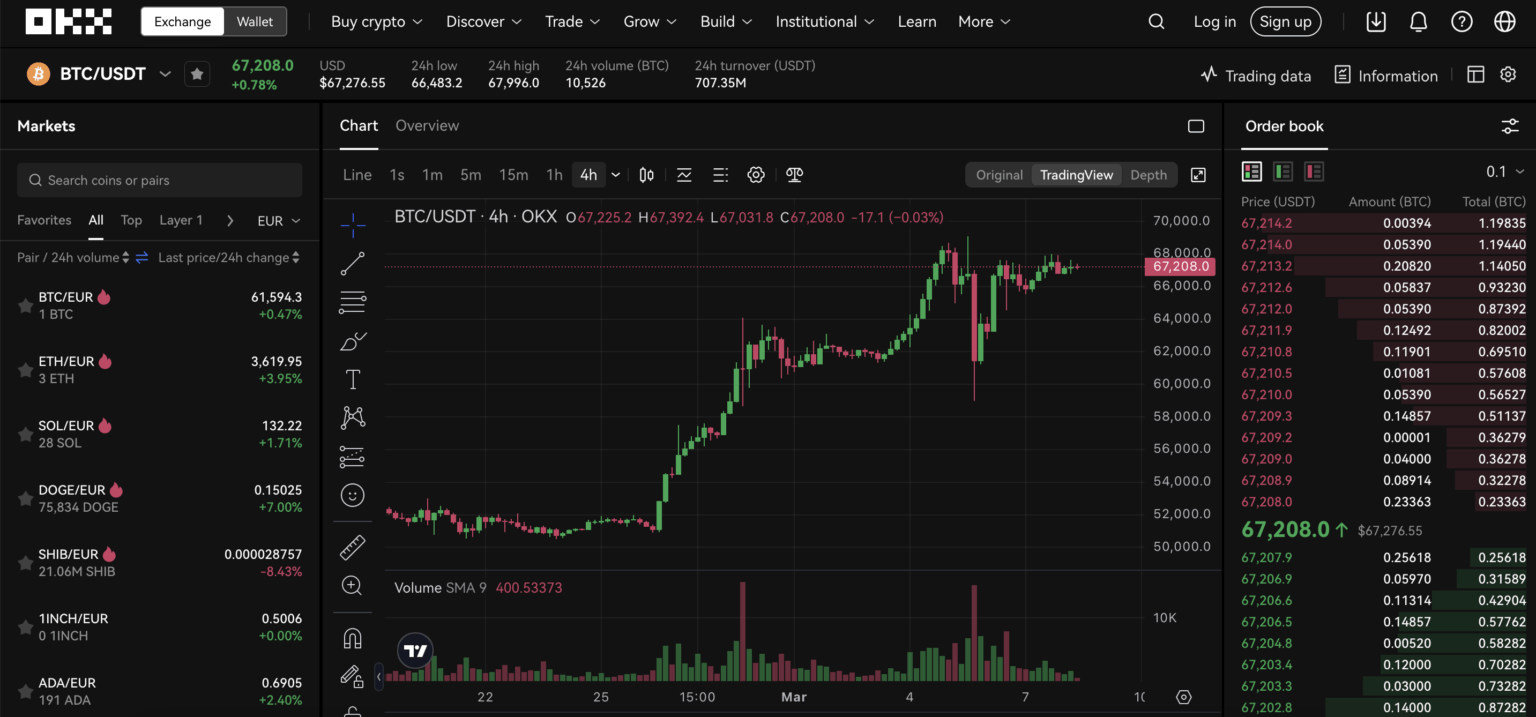
How OKX futures actually work: core mechanics and the leverage trade-off
Futures and perpetual swaps on OKX are margin instruments built on a matching engine that nets liquidity from takers and makers and imposes margin rules. Mechanically, when you open a leveraged futures position you are not borrowing from other users directly; instead the exchange uses internal margin accounting and a funding mechanism (for perpetuals) to align contract prices with spot. OKX offers up to 125x leverage on some instruments, and lower caps on others; margin mode choices—isolated versus cross—determine whether losses are capped to the position or can erode your whole account balance.
That mechanistic distinction matters for U.S. traders because regulators, tax rules, and access limitations can subtly shape which contracts are available and how aggressive you should be. High leverage increases liquidation probability non-linearly: a 10% adverse move destroys a 10x position but only disturbs a 2x. Futures also introduce funding payments, which are a recurring transfer between longs and shorts that can materially change carry costs if you hold over days or weeks. Recognize the economics: leverage amplifies both price exposure and the time-cost of carry.
Risk controls are concrete: auto-deleveraging in stressed liquidity events, maintenance margin thresholds, and insurance funds that absorb residual deficit when liquidations fail to close at acceptable prices. OKX publicizes an insurance buffer and Proof of Reserves to increase transparency, but those mechanisms are not a guarantee of zero loss. Insurance funds are finite; in extreme systemic events they can be exhausted, which is why position sizing and stress testing remain the trader’s primary defense.
OKX Web3 layer and wallet: connection points, custody boundaries, and phishing traps
Many readers think “wallet” and “account” are interchangeable; they are not. OKX combines a centralized exchange account (CEX) where the platform custody and matching engine operate, with a non-custodial Web3 wallet where you hold private keys and sign transactions. Mechanically, the wallet uses a seed phrase you control (and can integrate hardware wallets like Ledger/Trezor), while the CEX account requires KYC and stores most deposited assets in cold, multi-sig vaults. That hybrid model gives flexibility but introduces operational complexity.
If you want to trade perpetuals or futures, you must fund your CEX account. To participate in DeFi, mint NFTs, or interact with dApps aggregated by the OKX DEX, you can use the non-custodial wallet. Bridging assets between these domains usually involves on-chain transfers and therefore gas costs and possible smart contract risks. Importantly: losing a seed phrase on the non-custodial side means permanent loss; losing access to a CEX account can sometimes be remedied through KYC recovery but at the cost of identity disclosure.
Phishing and credential-theft remain the leading external risk. OKX employs AI-driven threat detection, mandatory 2FA options (biometrics, Google Authenticator, SMS), and cold storage for most assets. These are strong mitigations, but they are conditional: cold storage protects against platform-level hacks, not against social-engineering that transfers funds via an authorized session, and 2FA via SMS is vulnerable to SIM-swap attacks. A practical rule: prefer authenticator apps or hardware biometric 2FA and segregate funds between trading balances and long-term cold positions.
Common misconceptions and a sharper mental model
Misconception: “Proof of Reserves means my funds are guaranteed.” Correction: Proof of Reserves demonstrates a snapshot that assets held on-chain match liabilities at a point in time. It increases transparency and reduces asymmetric information, but it does not insure against operational misuse, future bankruptcies, or off-chain obligations the exchange may carry. Consider PoR as a transparency tool, not an insurance policy.
Misconception: “Higher leverage is just free amplification.” Correction: leverage interacts with liquidity and volatility to create path-dependent risk. Large positions in low-liquidity assets can incur slippage that defeats theoretical profit, and funding payments can invert expected carry. Mental model: treat leverage as a time-amplifier. The longer you keep a leveraged position, the more likely small cost flows (funding, fees, slippage) will erode P&L.
Operational heuristics for logging in and using OKX safely
If your immediate goal is to access the platform and start trading, follow this sequence: create the CEX account and finish KYC (necessary for fiat on-ramps and derivatives); enroll a non-SMS 2FA; then set up a separate non-custodial OKX Web3 wallet if you plan to use DeFi or NFTs. Use the platform’s biometric mobile app for convenience, but preserve a hardware-backed authenticator and the wallet seed in a secure, offline location. For a quick login path tailored to access, users can start at the official okx login page: okx login.
Segregate funds by role: a “trading float” on the exchange no larger than you would tolerate to lose within a day of market movement; a “reserve” in cold storage for long-term holdings; and a “dApp wallet” for experimental DeFi and NFTs where you accept smart contract risk. This three-pile approach aligns custody with function and risk tolerance.
Where the system breaks — limits and unresolved issues
There are realistic failure modes to watch. Cross-margin and high leverage can trigger cascades of liquidations in concentrated markets; during extreme volatility you may face partial fills and slippage that exceed calculated liquidation prices. Smart contract exploits can drain funds when you interact with DeFi through the Web3 wallet; OKX can reduce, but not remove, this risk. Finally, regulatory shifts in the U.S.—around derivatives, stablecoins, or KYC standards—could constrain product availability or change the onboarding process. These are structural limits, not temporary inconveniences.
What remains unresolved in public practice is how exchanges will balance rapid product innovation with stricter U.S. regulatory expectations. Exchanges that thread this needle successfully will likely make clearer segregation between institutional-grade custody services and retail-facing Web3 tooling. Monitor product notices, PoR updates, and any shifts in KYC policy as signals of that tension.
Decision-useful takeaways and a reusable framework
Three heuristics to reuse:
1) Function-first custody: choose where to place funds based on intended use—trading float on CEX for speed and leverage; cold wallet for long-term holding; Web3 wallet for composability.
2) Time-aware leverage: limit leverage proportional to expected trade duration—higher leverage for intraday scalps, much lower for swing trades—and always simulate worst-case slippage.
3) Multi-layer defense: combine hardware 2FA, non-SMS authentication, and email/SMS alerts, and treat each login session as potentially compromised until proven otherwise. Never reuse passwords across exchanges and Web3 services.
What to watch next
Short-term signals that would change how I allocate: any OKX announcement expanding or restricting U.S. derivatives availability; a meaningful change in PoR methodology; or a new cross-chain bridge exploit impacting OKX DEX liquidity. If you see these, re-evaluate margin, withdrawal cadence, and the size of your trading float immediately.
Longer term, watch the interplay between institutional custody standards and retail Web3 demand. If regulatory pressure forces clearer separation, the convenience of a single interface might give way to explicit trust boundaries—which would be healthy if it reduces unexpected counterparty exposure.
FAQ
Can I use my OKX Web3 wallet to trade futures directly?
No. Futures and derivatives execute on the centralized exchange ledger and require a funded CEX account. The Web3 wallet is for on-chain interactions. You must transfer assets on-chain to the exchange deposit address (or use a fiat/crypto on-ramp) to trade derivatives.
How should a U.S. trader think about KYC and privacy?
KYC is mandatory for full product access and withdrawal limits; it trades privacy for recoverability and compliance. Consider using minimal personal data for Web3 wallet activities that remain off-chain, but accept that CEX activity is subject to identity verification and recordkeeping.
Is Proof of Reserves a substitute for insurance?
Not by itself. Proof of Reserves improves transparency by showing on-chain backing at a point in time. It does not underwrite losses from operational failures, market contagion, or off-chain liabilities. Treat it as a verification tool, not an insurance policy.
What is the simplest anti-phishing step I can take right now?
Bookmark the official login URL and only use that bookmark to access the exchange. Use an authenticator app instead of SMS for 2FA, enable withdrawal whitelist for addresses, and double-check any unusual email or in-app prompt before approving transactions.